
Trying to have a baby can be an exciting experience, but when pregnancy does not happen as expected, it can become emotionally challenging.
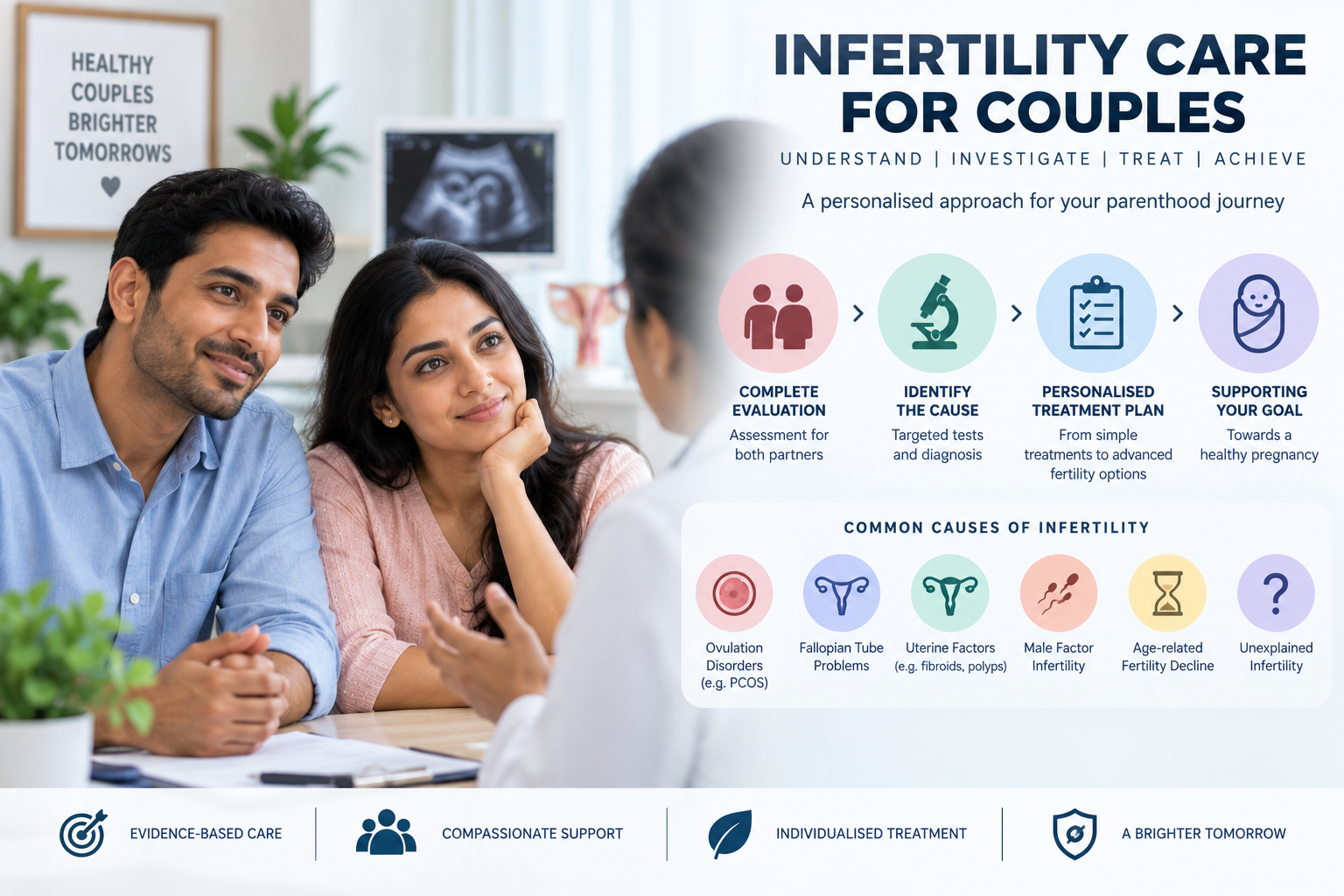
Infertility is a medical condition that affects both partners, and successful fertility care begins with evaluating the couple rather than focusing only on the woman.
The good news is that many causes of infertility can be identified and treated. Depending on the underlying problem, treatment may involve simple lifestyle changes, medication, surgery, ovulation induction, intrauterine insemination (IUI) or in-vitro fertilisation (IVF).
The right treatment is not necessarily the most advanced treatment. The goal is to choose the simplest effective treatment appropriate for the couple.
When should a couple seek help?
Traditionally, couples are advised to undergo an infertility evaluation when pregnancy has not occurred after 12 months of regular unprotected intercourse if the woman is under 35.
If the woman is 35 or older, evaluation is generally recommended after 6 months of trying.
Earlier assessment may be appropriate when there are irregular or absent periods, known endometriosis, previous pelvic surgery, previous chemotherapy, suspected tubal disease, recurrent pregnancy loss, erectile or ejaculation problems, or other known fertility concerns.
Age is an important factor because female fertility declines with increasing age, particularly due to changes in egg number and quality.
Infertility can involve either partner—or both
Infertility may result from female factors, male factors, a combination of factors or sometimes remain unexplained despite thorough evaluation.
Common female factors include:
- Ovulation disorders such as PCOS
- Reduced ovarian reserve
- Increasing age
- Endometriosis
- Blocked or damaged fallopian tubes
- Uterine fibroids or polyps in selected cases
- Adenomyosis
- Other hormonal or reproductive conditions
Male infertility can be related to:
- Low sperm count
- Poor sperm movement
- Abnormal sperm morphology
- Varicocele
- Hormonal disorders
- Previous infections or surgery
- Certain medications or medical conditions
- Genetic factors
In some couples, more than one factor contributes to difficulty conceiving.
The first step: A complete fertility evaluation
A fertility assessment begins with a detailed history.
Your doctor may ask about menstrual cycles, previous pregnancies, miscarriages, duration of infertility, previous surgeries, medical conditions, medications, sexual frequency and previous fertility treatments.
For the woman, investigations may include blood tests, pelvic ultrasound and assessment of ovulation and ovarian reserve when appropriate.
The fallopian tubes may be assessed using tests such as hysterosalpingography (HSG) or other appropriate imaging procedures.
The uterus may also be evaluated for fibroids, polyps, adhesions or other abnormalities.
For the man, semen analysis is one of the most important initial investigations.
A basic semen analysis provides information about sperm concentration, motility and morphology. If abnormalities are identified, repeat testing and further evaluation may be recommended.
Understanding ovarian reserve
Ovarian reserve refers broadly to the remaining quantity of eggs in the ovaries.
Tests such as AMH (anti-Müllerian hormone) and antral follicle count on ultrasound may provide information about ovarian reserve.
However, ovarian reserve testing should be interpreted carefully. A low or high AMH level does not, by itself, determine whether a woman can or cannot become pregnant naturally.
Age remains one of the most important factors influencing egg quality and reproductive potential.
Lifestyle and fertility
Lifestyle optimisation is an important part of fertility care for both partners.
Maintaining a healthy weight, exercising regularly, eating a balanced diet, avoiding tobacco and recreational drugs, limiting excessive alcohol and getting adequate sleep can support overall reproductive health.
Men should also discuss factors that may affect sperm production, including certain medications, anabolic steroids, excessive heat exposure and smoking.
A healthy lifestyle cannot overcome every cause of infertility, but it provides a strong foundation for treatment.
Treating the underlying cause
Once the evaluation is complete, treatment can be targeted.
For women who do not ovulate regularly, medications can be used to induce ovulation.
In women with PCOS-related anovulatory infertility, letrozole is generally considered first-line ovulation-induction treatment when there are no other infertility factors requiring a different approach.
Thyroid disorders, hyperprolactinaemia and other hormonal conditions may require specific treatment.
If a uterine polyp or cavity-distorting fibroid is identified, hysteroscopic treatment may sometimes improve the reproductive environment.
Blocked fallopian tubes may require surgical treatment or IVF depending on the location and severity of the blockage and other fertility factors.
Male infertility should be evaluated rather than simply bypassed. Depending on the cause, treatment may involve lifestyle changes, medical treatment, surgical correction or assisted reproductive techniques.
What is IUI?
Intrauterine insemination (IUI) involves placing prepared sperm directly into the uterus around the time of ovulation.
It may be considered in selected couples with conditions such as unexplained infertility, mild male-factor infertility or certain ovulation-related problems.
IUI is less invasive and less complex than IVF, but it is not appropriate for every couple.
What is IVF?
In-vitro fertilisation (IVF) involves stimulating the ovaries to develop multiple follicles, retrieving eggs, fertilising them with sperm in the laboratory and transferring an embryo into the uterus.
IVF may be recommended for conditions such as significant tubal disease, severe male-factor infertility, certain cases of endometriosis, reduced fertility associated with age, some cases of unexplained infertility or when previous treatments have not been successful.
In selected cases of severe male-factor infertility, ICSI (intracytoplasmic sperm injection) may be used, where a single sperm is injected directly into an egg.
IVF is highly useful, but it is not automatically the best first treatment for every couple.
Fertility treatment should be individualised
Two couples with the same diagnosis may receive different treatment recommendations.
Age, ovarian reserve, sperm parameters, duration of infertility, tubal status, previous treatments, medical history and personal preferences all influence treatment decisions.
The objective should not be to perform as many tests or treatments as possible. It should be to identify the most likely cause and select an evidence-based treatment pathway.
The emotional side of infertility
Infertility can affect relationships, confidence, mental wellbeing and family dynamics.
Partners may experience stress differently. One person may want to pursue treatment immediately, while the other may need more time.
Open communication is important. Infertility is a couple's medical journey, and neither partner should be blamed.
If the process becomes emotionally overwhelming, counselling or psychological support can be extremely valuable.
How long should treatment continue?
Fertility treatment should be reviewed periodically rather than continued indefinitely without reassessment.
If a treatment is unsuccessful, your doctor should discuss what the result means and whether the next step should be another attempt, a different treatment or additional evaluation.
The treatment plan should evolve according to the couple's response.
The most important message
Infertility does not mean that parenthood is impossible.
Modern reproductive medicine offers multiple options, and many couples eventually achieve pregnancy with appropriate evaluation and treatment.
The first step is not to panic and not to blame either partner.
Start with a systematic assessment of both partners, understand the likely cause, consider the simplest appropriate treatment and escalate treatment when clinically indicated.
Most importantly, fertility care should be compassionate as well as scientific. Every couple deserves a treatment plan that considers not only medical factors but also their age, priorities, expectations and emotional wellbeing.
If you have been trying to conceive without success, an early consultation with a fertility specialist can help identify the possible cause and guide you towards the most appropriate treatment pathway.
To book a consultation with our fertility experts in Sholinganallur, please click here to request an appointment.