
The thought of childbirth can be exciting, emotional and sometimes frightening—especially if it is your first baby.
Understanding what happens during labour and delivery can make the experience less stressful. While every birth is different, knowing what to expect can help you feel more prepared and confident.
Childbirth is not simply about the moment the baby is born. It is a process that begins with preparation for labour, continues through delivery and ends with important care for both mother and baby after birth.
How do I know that labour has started?
As your due date approaches, you may notice several changes.
True labour is usually characterised by regular uterine contractions that become progressively stronger, longer and closer together. These contractions cause the cervix to gradually thin and open.
You may also notice a "show", which is the passage of mucus from the cervix, sometimes mixed with a small amount of blood.
Another important sign is rupture of the membranes, commonly described as the "water breaking." This may happen before contractions begin or during labour.
If you think your waters have broken, contact your maternity team for advice, even if you are not experiencing contractions.
When should you go to the hospital?
Your doctor will give you individual instructions based on your pregnancy and medical history.
Generally, you should contact your maternity team if you have regular painful contractions, leaking of fluid, significant vaginal bleeding, reduced fetal movements or any other concerning symptom.
Women with high-risk pregnancies may be advised to come to hospital earlier.
It is useful to have your hospital bag, medical records and transport arrangements ready before the expected due date.
The stages of labour
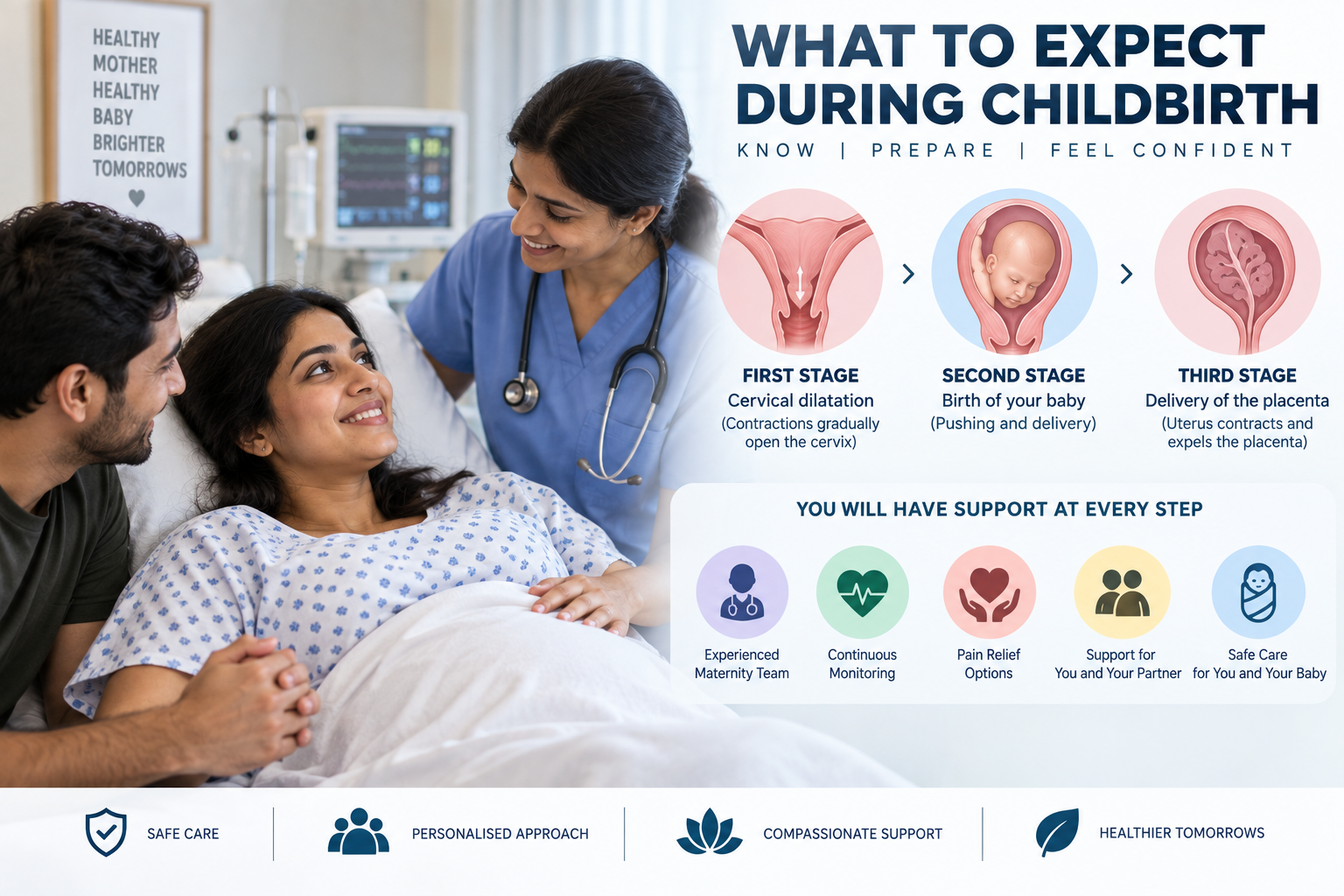
Labour is commonly described in three stages.
First stage: Cervical dilatation
The first stage begins when true labour starts and continues until the cervix is fully dilated. It is often divided into an early or latent phase and an active phase.
During this time, contractions gradually become stronger and more frequent while the cervix changes from being closed to fully dilated.
Your baby's heart rate will be monitored according to your individual circumstances and the hospital's protocol. Your vital signs and progress in labour will also be assessed.
Managing pain during labour
Pain during labour is a normal physiological experience, but women respond to it differently.
Several approaches can help, including:
- Breathing and relaxation techniques
- Movement and position changes
- Support from your birth partner or healthcare team
- Warm showers or other non-pharmacological methods where available
- Medication for pain relief
- Epidural analgesia, when appropriate and available
Choosing pain relief does not mean that you have failed at natural childbirth. The goal is to keep you safe, comfortable and supported.
Discuss your preferences with your obstetrician before labour so that you understand the available options.
The second stage: Birth of the baby
Once the cervix is fully dilated, the second stage of labour begins.
As the baby moves down through the birth canal, you may feel increasing pressure and an urge to push.
Your obstetrician or midwife will guide you through this stage.
When the baby's head is born, the shoulders and the rest of the body usually follow shortly afterwards.
Sometimes an episiotomy may be recommended, but it is not routinely required for every vaginal birth. Your doctor will assess whether it is necessary based on the circumstances.
What if labour does not progress normally?
Sometimes labour slows down or fails to progress as expected.
Your doctor may assess the contractions, cervical changes and baby's position. Depending on the circumstances, interventions may include adjusting medications used to strengthen contractions, changing maternal position or allowing additional time.
In some situations, an operative delivery may become necessary.
The purpose of monitoring during labour is to identify problems early and choose the safest course for mother and baby.
Assisted vaginal birth
In selected situations, a baby may need help to complete the final part of the birth.
Forceps or vacuum-assisted delivery may be considered when the baby's position is suitable but delivery needs to be expedited—for example, because of concerns about the baby's wellbeing or maternal exhaustion.
Your obstetrician will discuss the reason for assisted delivery and the expected benefits and risks whenever circumstances allow.
When is a caesarean section needed?
A caesarean section may be planned before labour or become necessary during labour.
Reasons may include placenta previa, certain abnormal fetal positions, previous uterine surgery in selected situations, fetal distress, failure of labour to progress or other maternal or fetal concerns.
A caesarean section is major surgery, but it is also an important and often life-saving method of childbirth when vaginal delivery is not the safest option.
The aim is always a safe mother and a healthy baby, rather than achieving one particular type of delivery at any cost.
The third stage: Delivery of the placenta
After your baby is born, the uterus continues to contract and the placenta separates from the uterine wall. This is the third stage of labour.
Medication such as oxytocin is commonly used to help the uterus contract and reduce the risk of excessive bleeding after birth.
Your healthcare team will monitor you closely during this period.
Immediately after your baby is born
If mother and baby are well, skin-to-skin contact soon after birth can be encouraged. It helps with bonding and may support the baby's transition after birth.
Breastfeeding can also be initiated early when possible. Your maternity team can help you with positioning, attachment and feeding.
The baby will undergo routine newborn assessment, including monitoring of breathing, heart rate, temperature and other important parameters.
Recovery after childbirth
The first few hours and days after delivery are an important period of recovery.
After vaginal birth, you may experience uterine cramps, vaginal bleeding, perineal discomfort and tiredness. After a caesarean section, recovery involves healing from abdominal surgery and usually takes longer.
Your doctor will monitor bleeding, blood pressure, pain, urination and other aspects of recovery.
Emotional wellbeing is equally important. Feeling tired or emotionally overwhelmed is common, but persistent sadness, anxiety, hopelessness or difficulty bonding with your baby should be discussed with your healthcare provider.
Preparing for childbirth
Good preparation can make childbirth less stressful.
Attend your antenatal appointments, understand your pregnancy and discuss your birth preferences with your obstetrician. You can ask about:
- Signs of labour
- When to come to hospital
- Pain relief options
- Vaginal birth and caesarean birth
- Induction of labour
- Breastfeeding
- Newborn care
- What happens if an unexpected situation develops
Remember that a birth plan is a guide—not a guarantee. Labour can be unpredictable, and sometimes the safest plan needs to change.
Every birth is unique
There is no single "perfect" way to give birth.
For some women, labour progresses naturally and ends in an uncomplicated vaginal birth. Others may require induction, assisted delivery or caesarean section.
What matters most is that you and your baby receive appropriate care throughout the process.
Understanding childbirth, asking questions and having a trusted maternity team can help you approach delivery with greater confidence.
Your body is preparing for one of life's most remarkable experiences. With good antenatal care, informed preparation and the right support, you can enter childbirth feeling prepared, supported and cared for.
To book a consultation with our experts in Sholinganallur, please click here to request an appointment.